



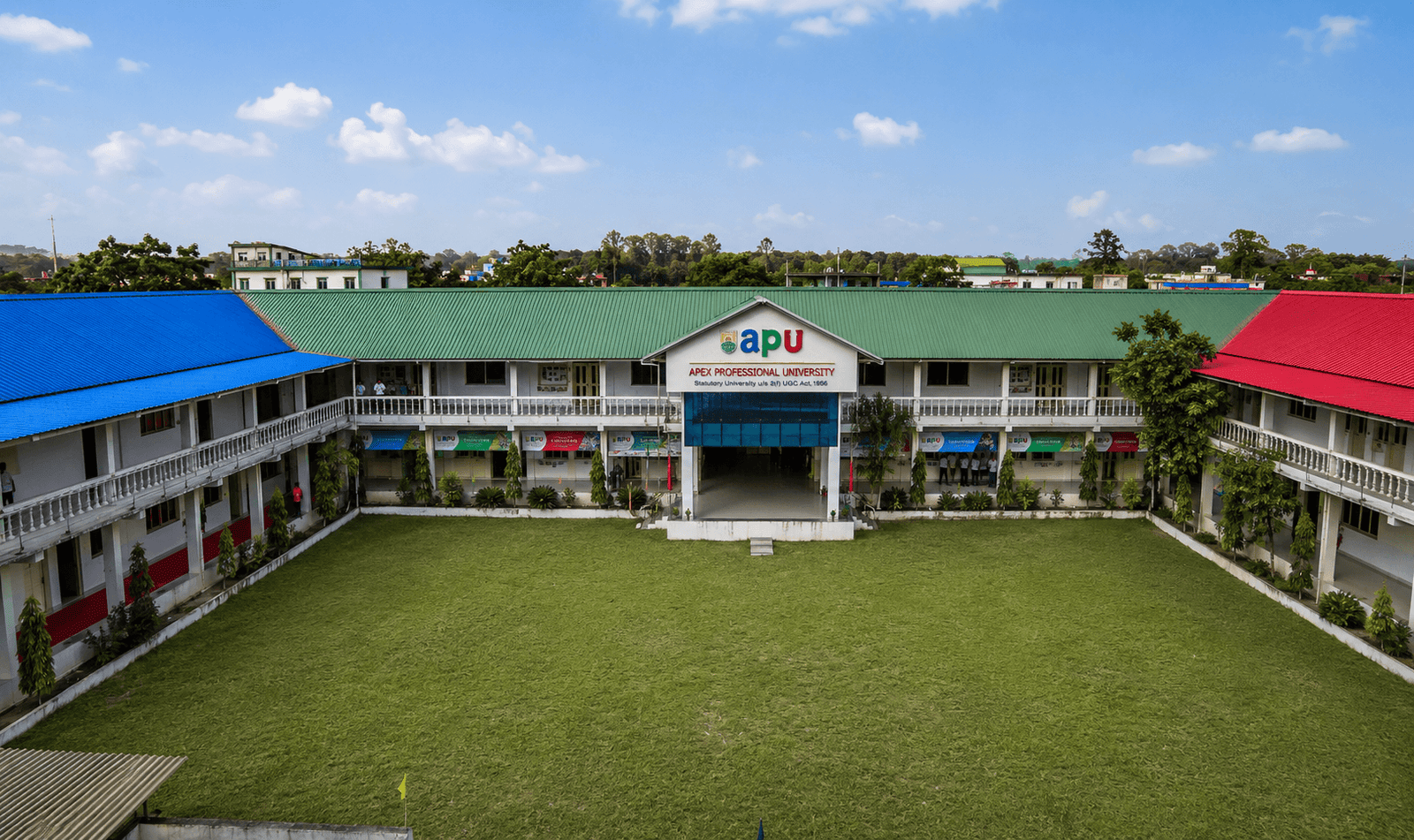
If you want an MBA and you are from the Northeast, you no longer have to leave the region to get a good one. The best MBA colleges in Northeast India now range from IIM Shillong at the top to a solid group of university-run programmes across Assam, Arunachal Pradesh and the neighbouring states — including a UGC-approved, industry-linked MBA at Apex Professional University in Pasighat, within easy reach of Upper Assam.
There is a lot of noise online, most of it copied from one listicle to the next. This guide does something different: it explains how to actually judge an MBA college, names the honest options, and helps you match a programme to the career you want — not the college with the biggest ad budget.
Table of Contents
ToggleWhy doing your MBA in the Northeast makes sense now
For years, a good MBA was assumed to mean a flight to Delhi, Pune or Bengaluru. That assumption is out of date. The region has its own IIM, a cluster of central and state universities running recognised management programmes, and a real employer base — banks and NBFCs, tea and agri-business, tourism, healthcare, retail chains, and a young start-up scene centred on Guwahati — that hires locally.
Staying closer to home has advantages nobody prints in a brochure. Lower living costs. Family support through two demanding years. And a network rooted in the region where you actually want to build a career. For a student in Dibrugarh, Dhemaji, North Lakhimpur or Tinsukia, a campus just across the river in Arunachal can be far more reachable than a metro two flights away.
What actually makes an MBA college ‘good’
Ignore rankings for a minute. Before any list means anything, judge a college on five things that decide whether the degree pays off. Use these as your shortlist filter.
1. Recognition you can verify yourself
The degree must come from a university recognised by the University Grants Commission (UGC). This is not a nice-to-have. An unrecognised MBA can quietly cost you government-job eligibility, PSU roles and further study. If a college is vague about its recognition, treat that as your answer and move on.
2. Faculty who have done the job, not just taught it
The gap between a forgettable MBA and a useful one is usually the faculty. Look for teachers with real corporate or consulting experience, regular industry guest speakers, and live projects instead of only textbook cases. Ask to meet a couple of them on your campus visit.
3. Specialisations that match where the jobs are
Marketing, Finance and HR are the classics for good reason, but the strongest programmes now add streams that are actively hiring — business analytics, digital marketing, healthcare and hospital management, agri-business, international business. Choose the stream for the career, not the label.
4. Internships and placement support
Ask one blunt question on your visit: “Where did last year’s batch actually go?” A serious college shows you named recruiters, internship partners and a placement cell that starts working in year one — not the week before you graduate.
5. Total cost you can finance without regret
A regional MBA should be markedly cheaper than a metro private B-school for a comparable, recognised degree. Add up tuition, hostel and living costs over the full two years, then set scholarships against it. The total is what matters, not the tuition line alone.
The best MBA colleges in Northeast India
Here are the options worth shortlisting, grouped by type. Treat this as a guide, not a rigid ranking — the ‘best’ college is the one that fits your specialisation, budget and career plan. Confirm current approvals and fees on each college’s own website before you apply.
The regional flagship
IIM Shillong (Meghalaya) is the region’s premier B-school and the benchmark for the Northeast. Entry is through CAT and it is highly competitive, but it anchors the region’s management reputation. If your profile and CAT score are strong, it is the obvious first target.
University-based MBA programmes
Most students will do their MBA at a university rather than a standalone IIM, and this is where the real choice sits — central and state universities across Assam and the neighbouring states, plus recognised private universities running industry-linked programmes. Shortlist two or three, compare them on the five points above, and visit if you can.
A closer look: the MBA at Apex Professional University (APU)
APU is a UGC-approved state private university, established by an Act of the Government of Arunachal Pradesh in 2013, and a member of the Association of Indian Universities (AIU). In plain terms, the degree is recognised and it travels — you can use it for jobs, government eligibility and further study anywhere in India.
Its MBA is built to be practical rather than purely academic. The university runs the MBA in an internship-embedded format, with executive and part-time variants for working professionals, and specialisation streams across areas such as Marketing, Finance, Human Resource Management, International Business and Information Technology. Because the campus sits about 17 miles from Jonai on the Assam border, it is genuinely reachable for students across Upper Assam who want a recognised MBA without moving far from home.
One thing sets APU apart from a standard B-school: it blends the Indian Knowledge System (IKS) with contemporary management — leadership and self-management drawn from Indian traditions alongside modern tools and analytics. If that combination appeals to you, it is a real point of difference.
MBA specialisations: which stream fits you?
Your specialisation shapes your first five years of work more than the college name does. Here is a straight read on the main streams and who each suits.
Specialisation | Best for | Typical early roles |
Marketing | People who like persuasion, brands and data | Brand/product, digital marketing, sales strategy |
Finance | Numbers-comfortable, analytical students | Banking, financial analysis, corporate finance |
Human Resources | People-focused, strong communicators | Talent, L&D, HR business partner |
Business Analytics | Logical, tech-friendly problem-solvers | Data/BI analyst, insights |
International Business | Global outlook, trade interest | Export–import, trade, global ops |
Healthcare / Hospital Mgmt | Care-sector interest with a business head | Hospital admin, health operations |
MBA admission in the Northeast: how it works
Most programmes accept national entrance scores — CAT, MAT, XAT or CMAT — and many universities also run their own entrance test or admit on merit from your graduation marks. General eligibility is a bachelor’s degree in any discipline, usually around 50% aggregate, relaxed for reserved categories. A typical path:
- Finish a recognised bachelor’s degree in any stream.
- Take an accepted entrance exam (CAT/MAT/CMAT/XAT) or the university’s own test.
- Apply online, attend counselling or interview where required, and confirm your seat.
- Line up scholarships and an education loan before you pay — most universities, APU included, offer merit scholarships worth asking about.
How to choose — a simple final filter
Stuck between two colleges? Decide in this order: recognition first (is the university UGC-recognised and the degree valid everywhere?), then specialisation and faculty, then placement track record, then total cost. For most careers, fit beats prestige. A recognised, well-taught, affordable MBA you actually finish and use will out-earn a famous name you took on heavy debt to attend.
Frequently asked questions
Which is the best MBA college in Northeast India?
IIM Shillong is the region’s flagship and the top choice for strong CAT scorers. Beyond it, several UGC-recognised university MBAs — including the industry-linked programme at Apex Professional University in Arunachal Pradesh — suit most applicants better on cost and access. The ‘best’ one depends on your specialisation and budget.
Is an MBA from a Northeast university valid across India?
Yes, as long as the university is UGC-recognised. A UGC-approved MBA is valid for jobs, government eligibility, PSUs and further study anywhere in India. Always verify a university’s recognition on the UGC site before applying, rather than relying on a prospectus.
Can students from Assam do an MBA in Arunachal Pradesh?
Absolutely. Universities in Arunachal, such as Apex Professional University near the Assam border at Jonai, admit students from across the Northeast. For Upper Assam students it is often closer and more affordable than a metro programme, with the same national recognition.
What is the eligibility for MBA admission?
You need a bachelor’s degree in any discipline, usually around 50% aggregate (relaxed for reserved categories). Most colleges accept CAT, MAT, CMAT or XAT scores, and many also run their own entrance test or admit on merit from your graduation marks.
How much does an MBA cost in the Northeast?
It varies, but regional universities are generally far more affordable than metro private B-schools for a comparable recognised degree. Add hostel and living costs to tuition, then ask each college about merit scholarships and education-loan tie-ups before deciding.