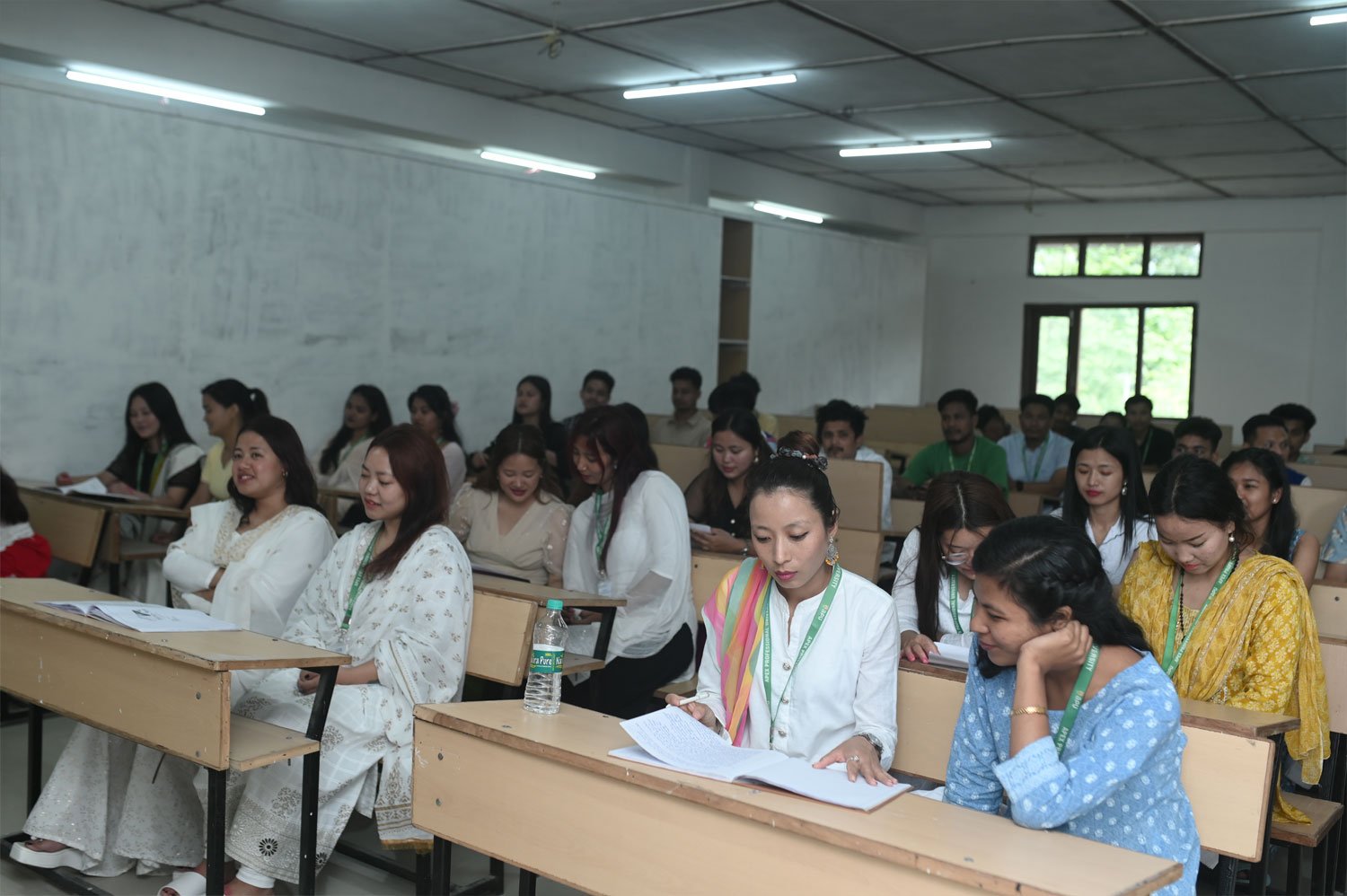
Doctor of Philosophy (Ph.D.) program offered by the Institute of Research and Innovation (IRI) at Apex Professional University approved by the University Grants Commission (UGC).
- Overview
- Entrance Test
- Eligibility
- Career Opportunities
The Doctor of Philosophy (Ph.D.) program is a rigorous course of advanced and original research that prepares students for a lifetime of field-defining scholarship, intellectual leadership and teaching in the area of Indian philosophy, Western philosophy and interdisciplinary studies. It aims to form scholars and academicians through constructive, critical engagement with Indian philosophical tradition in its complexity and diversity, and where appropriate, in conversation with other intellectual traditions in their multiplicity and variety.
The research areas broadly include Indian Darshanas, Classical and folk arts, Architecture and Literature, History of Ancient Indian Sciences, Indian Polity and Economy, and Comparative Studies. The Ph.D. program nurtures excellence in (1) research and writing, and (2) teaching. This program provides doctoral students with the opportunity to develop expertise in their chosen discipline through the completion of a supervised research project.
The Research Entrance Aptitude Test (TREAT) shall be of one and a half hours duration (i.e., 90 minutes), consisting of 100 MCQs of 100 marks in total and with no negative marking. The entrance test will have two sections (administered in one go), as mentioned hereunder:
| PARTICULAR | COMPONENT | QUESTIONS | MARKS |
| SECTION 1 – GENERAL | Section 1 shall be common to all candidates for testing their aptitude in research by covering questions from the following areas for research methodology:
| 50 Questions of 1 mark each | 50 marks |
| SECTION 2 – SUBJECT SPECIFIC | Section 2 shall be Subject Specific as per the applied Ph.D. programme of the applicant. This section shall be divided into two parts – 25 questions shall be purely from the PhD Program subject & 25 questions from either the PhD Program subject or any related and offered allied field. The difficulty level is UGC-CSIR-NET, GATE, etc./Masters level of the subject | 50 Questions of Master’s level of 1 mark each | 50 marks |
| INTERVIEW BY FACULTY RESEARCH COMMITTEE (FRC) – Only for TREAT-qualified and TREAT-exempted candidates | 30 marks | ||
The required minimum qualification for admission to a Ph.D. programme is
- Master’s from a recognised Indian or foreign university/institute in the relevant field with a minimum of 55% marks or Equivalent CGPA OR
- A four-year bachelor’s Degree from a recognised Indian or foreign university/institute in the relevant field with a minimum of 75% marks or Equivalent CGPA
Applicants who have a Chartered Accountancy (CA) qualification from 'The Institute of Chartered Accountants of India' (ICAI), Cost and Works Accountancy of ICWAI, or Company Secretary of ICSI with at least 55% marks or an equivalent grade may be allowed to apply for Ph.D. programs in the relevant field.
Foreign and NRI applicants, as well as those holding a master’s degree from a foreign university, must submit an equivalence certificate from AIU along with their online application form.
A relaxation of 5% marks will be allowed in the entrance examination for the candidates belonging to the SC/ST/OBC/differently-abled category, Economically Weaker Section (EWS), and other categories of candidates as per the decision of the Commission from time to time.
Exemption from Entrance Test
Applicants who have qualified for the UGC (NET/JRF)/CSIR (NET/ JRF) examination/valid GATE or GPAT scorecard or passed the M.Phil. Programme (in regular mode only) are exempted from the TREAT (PhD Entrance Test).
The selection of candidates based on the entrance test conducted by the HEI shall have a weightage of 70 % for the entrance test and 30 % for the performance in the interview/viva voce.
A Ph.D. opens diverse career pathways in academia, research, and industry. Graduates can become university faculty, research scientists, policy advisors, or corporate consultants. Opportunities also exist in data science, innovation management, think tanks, and international organizations. Many Ph.D. holders venture into entrepreneurship or science communication. The degree signifies expertise, critical thinking, and leadership—skills essential for high-impact roles across sectors.
One of the most commonly known career paths after a PhD is to become a professor. This enables you to work as a faculty in educational institutions. As a professor, you require all-round skills along with your primary teaching skills. You need to have planning, communication, delegation, research, and administrative skills. You can work in government universities or private universities as per your inclinations. A few top educational institutions for professors in India are IITs, IIMs, Delhi University and Apex Professional University.

Course Work
Coursework is mandatory for all students admitted in Ph.D. Programme.
The coursework will have a minimum of 12 credits.
All candidates admitted to the Ph.D. programme will be required to complete the coursework prescribed by the university during the initial one or two semesters.
The coursework shall consist of the following four courses:
- Course I: Research Methodology
- Course II: Research & Publication Ethics
- Course III: Core Subjects of Research
- Course IV: Research Seminar
Minimum 75% Aggregate attendance is mandatory in the coursework. The minimum passing marks required in the coursework of the Ph.D. programme are 55% aggregate in the individual courses, with at least 40% in the final term-end examination.
Coursework options for Ph.D. Scholars except Agriculture
| Preference | Duration | Spring Term (January Intake) | Autumn Term (August Intake) | Class Timings |
| Option I | Every Weekend | January – April | August – December | Saturdays 02:00 P.M.- 05:00 P.M. Sundays 09:00 A.M.- 05:00 P.M. |
| Option II | 4 days | January – April | August – December | 09:00 A.M.- 07:00 P.M. 3rd Week of every month (Thu, Fri, Sa, Su) |
| Option III | 15 days | May / June | November / December | 09:00 A.M.- 07:00 P.M. (daily) |
Note:
- The coursework options listed under preference exercised by the scholar will only be offered subject to fulfilment of minimum number of scholars opting for that given option. If an option lacks sufficient interest, it may not be offered, and scholars must choose from the available alternatives.
- For option II classes are to be conducted Thursday to Sunday of every third week of all 4 months.
- Induction programme will be conducted before the start of every coursework option.
- The contact hours in all these options will remain same. If number of Research Scholars in any option is less, then that option may not be offered.
Coursework Exemption:
Exemption in course work will be applicable only if scholar has done M.Phil. (regular mode) with 55% or equivalent grade ‘B’ in the UGC 7-point scale through regular mode from LPU or any other recognized university.
Downloads

Program Highlights
The APU PhD is modelled on the new UGC guidelines of PhD Programs. . Presently, APU is providing admission to the PhD for full-time & part-time research in Law and Forensic Sciences, Education and Social Sciences, Life & Health Sciences, Management and Technology, Naturopathy and Yogic Sciences, Astrology & Vastu Shastra.

Attendance Policy
The Ph.D. scholars need to attend the mandatory course work at University campus. Scholar will be required to maintain 75% attendance during the course work to be eligible to attend end-term examination.Ph.D. research scholars for whom the Pre-Submission evaluation is recommended, will be exempt from the attendance requirements.

Allotment of Supervisor
The allocation of supervisors should be based on a transparent framework of shared responsibilities between the Ph.D. scholar and the supervisor. The role of the Ph.D. supervisor should be to encourage, challenge, and support the scholar so that he/she may develop the skills. A positive and collaborative interaction between scholar and supervisor will enhance the scholar experience and increase the prospects for a successful outcome for the Ph.D. Programme.

Fee & Allied Issues
The Progress evaluation fee and programme fee as mentioned above shall be paid for all terms (semesters) till the final Ph.D. submission. CIF charges are applicable in case the services are used only; at subsidised rates. Program Fee is to be paid by the research scholars as per schedule otherwise research scholar may get de-registered from the programme.
Admission Process
Apex Professional University is conducting the National Level Entrance Test (TREAT) for the Ph.D. aspirants. Research Scholars studying in Post-Graduation can apply for TREAT. Selection of research scholars shall be based on the performance in both the written test and the interview to be conducted by the University twice in a year (July and December).

FILL APPLICATION
Complete the Detailed Admission Form and mention the score obtained in the National Tests like CUET / NEET / CLAT / GATE etc.

PAY APPLICATION FEE
Pay the Application Processing Fee Rs. 2,500/- (non- refundable) via Credit/Debit Card, UPI, or NetBanking to complete your Admission Form.

UPLOAD DOCUMENTS
Applicants must appear for the National Level Entrance Test (TREAT). UGC NET qualified candidates are exempted.

ENTRANCE TEST
Applicants must appear for the National Level Entrance Test (TREAT). UGC NET qualified candidates are exempted.

FINAL SELECTION
Final selection is based on Entrance Test (70%) and Interview (30%). For exempted candidates, Interview carries 100% weightage.


In Our Labs and Our Classrooms
Big Ideas are Nurtured
Research Fellowship
Full-time Ph.D. scholars are eligible for a monthly fellowship ranging from ₹18,600 to ₹25,000, based on UGC - NET Score, academic qualifications, research performance, and university norms.
Flexible Enrollment Modes
Ph.D. programs are offered in Full-time mode with fellowship support, Part-time for Remote Research options designed specifically for working professionals.
Dedicated Research Cell
Research & Development Cell facilitates interdisciplinary & funded research and provides guidance for research grants and publications.