



Table of Contents
ToggleStudying in Arunachal Pradesh: Permits, Costs, Weather and Everything Nobody Tells Outstation Students
Arunachal Pradesh is one of the least understood places in India to be a student. Most people outside the Northeast could not point to it on a map, and the questions that follow an offer letter tend to be the same ones: do I need a permit, how far is it really, is it safe, what does it cost, and what happens in the monsoon.
Here are the answers, including the ones that are inconvenient.
The Inner Line Permit — what it is and how you get one
Arunachal Pradesh is a protected area under the Bengal Eastern Frontier Regulation. Indian citizens who are not residents of the state need an Inner Line Permit to enter. It is not a visa and it is not difficult. It is a permit, and getting one is routine.
For students, the usual sequence is: you receive your admission letter, the university supports your ILP application, and you obtain a permit for the duration of your course or for a period that is then renewed. Applications can be made online through the state’s eILP portal or in person at Arunachal Pradesh government offices, including in Guwahati and other locations outside the state. You will need photo ID, photographs and a small fee.
Residents of Arunachal Pradesh do not need one. Foreign nationals need a Protected Area Permit instead, which is a separate and more involved process.
The practical points people get wrong:
- Apply before you travel, not on arrival
- Keep a digital and a printed copy — you may be asked at the check gate on the way in
- Note your expiry date in your phone calendar and renew before it lapses
- Family members visiting you also need one, so plan ahead for parents’ visits
Getting there
Pasighat is in East Siang district, in the eastern part of the state on the Siang river, and it is one of Arunachal’s oldest towns.
By air. Pasighat has an airport with connections to [VERIFY current routes and frequency]. The larger regional airport is Dibrugarh in Assam, roughly [VERIFY] away by road. Guwahati is the main gateway for the Northeast.
By rail. The nearest railheads are in Assam — [VERIFY nearest stations and distances, likely Murkongselek and Dibrugarh]. Most students arriving from outside the region come by train to Assam and complete the journey by road.
By road. Shared taxis and buses run from Dibrugarh and other Assam towns. Journey times stretch in the monsoon.
Plan on the door-to-door journey taking most of a day from anywhere outside the Northeast. From Dibrugarh, Tinsukia or Sivasagar it is a manageable half-day, which is why so many Upper Assam students find Arunachal campuses more practical than Guwahati.
What it actually costs to live there
Living costs in Pasighat are low by national standards and lower than Guwahati.
Hostel and mess charges at Apex Professional University are [INSERT — VERIFY]. Beyond that, a realistic monthly figure for personal expenses — mobile data, toiletries, occasional meals out, laundry, stationery — is [VERIFY range].
The costs people forget:
Travel home. Budget for two or three round trips a year. From outside the Northeast this is the single largest non-fee expense and it is worth calculating before you accept an offer.
Warm clothing. Pasighat is in the foothills rather than the high mountains, so winters are mild compared with Tawang or Ziro — but if you are coming from Kerala or Tamil Nadu you will still want something warmer than you own.
Monsoon gear. Not optional. See below.
The weather, honestly
Arunachal Pradesh receives some of the heaviest rainfall in India, and the Siang valley gets a substantial share of it. The monsoon arrives early — around May — and continues through September. During those months, expect rain most days, and expect it to be heavy.
What that means in practice: roads get affected, journey times lengthen, occasionally travel is disrupted for a day or two. Power cuts happen. Humidity is high.
October through April is genuinely lovely. Clear, mild, and the valley is spectacular.
Nobody is going to tell you this on an admission call, so: if you cannot cope with four months of serious rain, factor that in now. Most students adapt within a term. Some do not enjoy it.
Safety, and what parents are actually asking
Arunachal Pradesh is generally a peaceful state and Pasighat is a small, close-knit town where people know each other. That is a genuine safety asset in a way that large cities are not.
The practical picture for a student: campus and hostel security, a town small enough to walk, and a community where a stranger stands out. Universities in the state run hostel curfews and gate registers, and for many parents that is precisely the reassurance they want.
The real adjustments are not safety-related. They are distance from home, limited late-night options, and a smaller town than many students are used to.
Culture, food and fitting in
Arunachal Pradesh has more than twenty-five major tribal communities and over a hundred dialects. Adi, Nyishi, Apatani, Galo, Monpa, Mishmi and many others, each with distinct traditions. Pasighat is predominantly Adi.
Hindi and English are widely used, and English is the medium of instruction. You will not have a language problem.
Food is rice-based with plenty of boiled and steamed preparations, local greens, bamboo shoot, fermented items and fish. It is lighter and less oily than most of mainland Indian cooking, and many students take a few weeks to adjust. Vegetarian food is available but the range is narrower than you may be used to — worth knowing if that is a strict requirement. Ask specifically about mess arrangements.
Festivals are a real part of the calendar. Solung, Mopin, Nyokum, Losar. If you are there for one, go.
What is genuinely good about studying here
Smaller batches. You will know your faculty and they will know your name. At scale this is impossible; here it is normal.
Cost. Total cost of study and living is meaningfully lower than in metros and lower than Guwahati.
Less competition for seats in programmes that are heavily oversubscribed elsewhere.
The place itself. The Siang valley is beautiful in a way photographs undersell. Students who take to it take to it completely.
Proximity for Upper Assam students. If you are from Dibrugarh or Tinsukia, this is closer than most of the options in your own state.
What is genuinely harder
Fewer part-time job and internship options locally than in a city.
Fewer entertainment and retail options — this is a small town.
Travel home is longer and more expensive for students from outside the Northeast.
Monsoon, as covered.
Fewer institutions, so if you decide to switch you have less choice within the state.
None of these are dealbreakers. All of them are worth knowing before you arrive rather than in week three.
Universities in Arunachal Pradesh
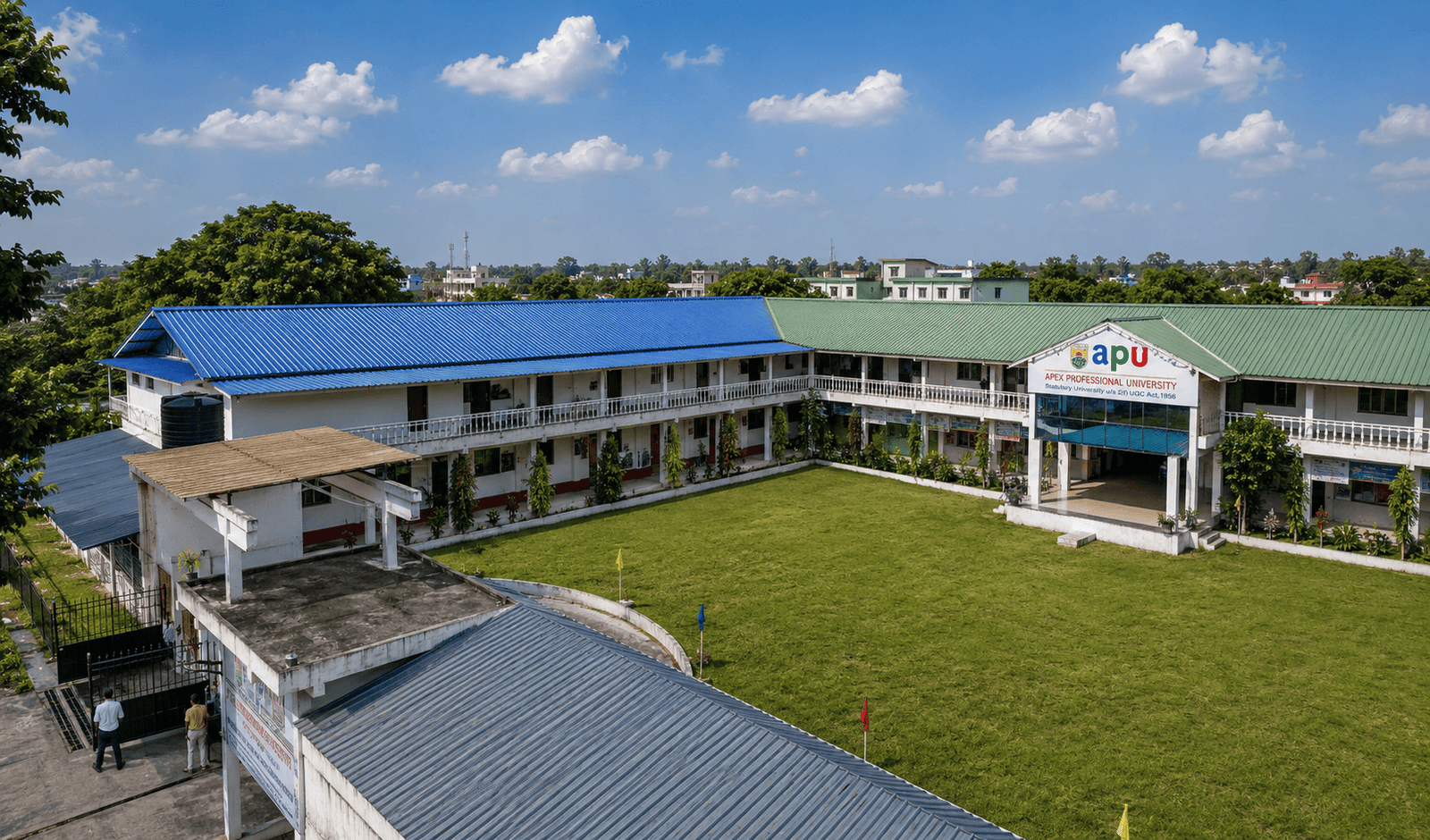
Rajiv Gandhi University in Doimukh, near Itanagar, is the state’s central university. NIT Arunachal Pradesh serves engineering. Several state private universities operate across the state, including Apex Professional University in Pasighat, which offers programmes in [INSERT list — VERIFY].
We have compared the options in [Best University in Arunachal Pradesh → existing post 10], and the verification method for any of them is in [How to check a UGC approved university → Post 2].
If you are weighing Arunachal against Assam, [Top Universities in Assam → Post 1] gives the other side.
A checklist before you accept an offer
- Confirm UGC recognition and programme-level regulator approval, in writing
- Confirm the ILP process and what support the university gives you
- Get the full annual cost — fees, hostel, mess, exam fees — in one written figure
- Ask about hostel arrangements, medical facility and emergency contact protocol
- Work out your travel route home and price two round trips
- Talk to a current student from your home state if you can. Ask the admissions office to connect you; a good one will
- Visit if it is at all possible. One day on campus answers more than fifty phone calls
Frequently asked questions
Do students need an Inner Line Permit for Arunachal Pradesh?
Yes. Indian citizens who are not residents of Arunachal Pradesh need an Inner Line Permit to enter the state, including students. It can be applied for online through the state’s eILP portal or at Arunachal Pradesh government offices, and universities usually assist enrolled students with the process.
Is Arunachal Pradesh safe for students?
Arunachal Pradesh is generally peaceful, and towns like Pasighat are small and close-knit, which many families find reassuring. Universities operate hostel security, gate registers and curfews. The main adjustments for outstation students are distance from home and small-town living rather than safety concerns.
How much does it cost to study in Arunachal Pradesh?
Living costs are low compared with metros and generally lower than Guwahati. Total cost depends on the programme and institution, and the largest hidden expense for students from outside the Northeast is travel home two or three times a year. Ask for a full written annual figure.
How do I reach Pasighat?
Pasighat has an airport, and the nearest major transport hubs are in Assam — Dibrugarh for both air and rail. Most students from outside the region travel to Assam by train or air and complete the journey by road. Allow most of a day door to door.
What is the weather like in Arunachal Pradesh?
The state receives very heavy rainfall, with the monsoon running roughly May to September. Pasighat sits in the foothills, so winters are mild rather than severe. October to April is pleasant and clear. Monsoon months bring frequent heavy rain and occasional travel disruption.
Can students from other states study in Arunachal Pradesh?
Yes. Universities in Arunachal Pradesh admit students from across India, subject to obtaining an Inner Line Permit. Fees are generally the same regardless of home state at private universities. Apply early for hostel accommodation, which is the practical constraint.
Is there vegetarian food available in Arunachal Pradesh?
Yes, though the range is narrower than in most of mainland India and local cuisine is largely non-vegetarian and rice-based. University messes usually provide vegetarian options. If you have strict dietary requirements, ask the institution about mess arrangements specifically before accepting an offer.
Which is the best university in Arunachal Pradesh?
It depends on your subject. Rajiv Gandhi University is the state’s central university, NIT Arunachal Pradesh serves engineering, and several state private universities offer professional programmes including law, pharmacy, nursing and education. Compare by department and by regulator approval rather than by institution name.
The honest summary
Arunachal Pradesh suits students who want a small campus, low costs and a programme that is right for them, and who are not going to be miserable four hours from a shopping mall. It does not suit everyone. If it suits you, it suits you very well.